

We all know the moment. A message arrives with the wrong tone. A meeting shifts. A family comment lands harder than expected. In a few seconds, the body tightens, the mind races, and our response starts forming before we have truly understood what we feel.
Real-time emotional self-calibration is the skill of noticing our inner state and adjusting it before it turns into harmful action.
This is not about becoming cold, silent, or distant. It is about staying present enough to respond with clarity. We think this matters because many emotional mistakes do not begin with bad intentions. They begin with speed. We react too fast, speak from strain, and only later see the cost.
There is good support for this kind of practice. A systematic review and meta-analysis on mindfulness and induced emotions found that mindfulness-based methods reduced negative emotional responses in both self-report and biobehavioral measures. That matters in daily life, because it shows that emotional regulation is not only an idea. It can be trained.
Why self-calibration has to happen in real time
Many people reflect well after the fact. They can say, “I was defensive,” or “I was more anxious than I thought.” That insight has value, but real change grows when awareness appears during the moment itself.
We have seen this in ordinary situations. Someone walks into a conversation already tired. The other person is brief. The tired mind reads rejection where there may be none. Then comes the sharp reply. Then distance. The event seems social, but the trigger was internal.
Speed can distort truth.
Real-time self-calibration helps us slow the chain between trigger and reaction. We do not stop feeling. We stop handing the wheel to the first wave.
Start with the body, not the story
When emotion rises, many of us try to think our way out at once. We search for reasons, assign blame, or defend our position. But the body often gives the first honest signal.
The body usually notices emotional change before the mind explains it.
So a simple first practice is a body check that takes less than twenty seconds. We can ask:
Is my jaw tight?
Has my breathing become shallow?
Do I feel heat in the chest or face?
Are my shoulders raised?
This short pause interrupts automatic momentum. It also keeps us from creating a dramatic inner story too early. If we say, “My chest is tight and my breath is short,” we are dealing with something real. If we say, “This always happens to me,” we are already building a larger narrative.

Use the three-step reset
When emotions rise fast, we need a method simple enough to use under pressure. We often suggest a three-step reset because it is short and practical.
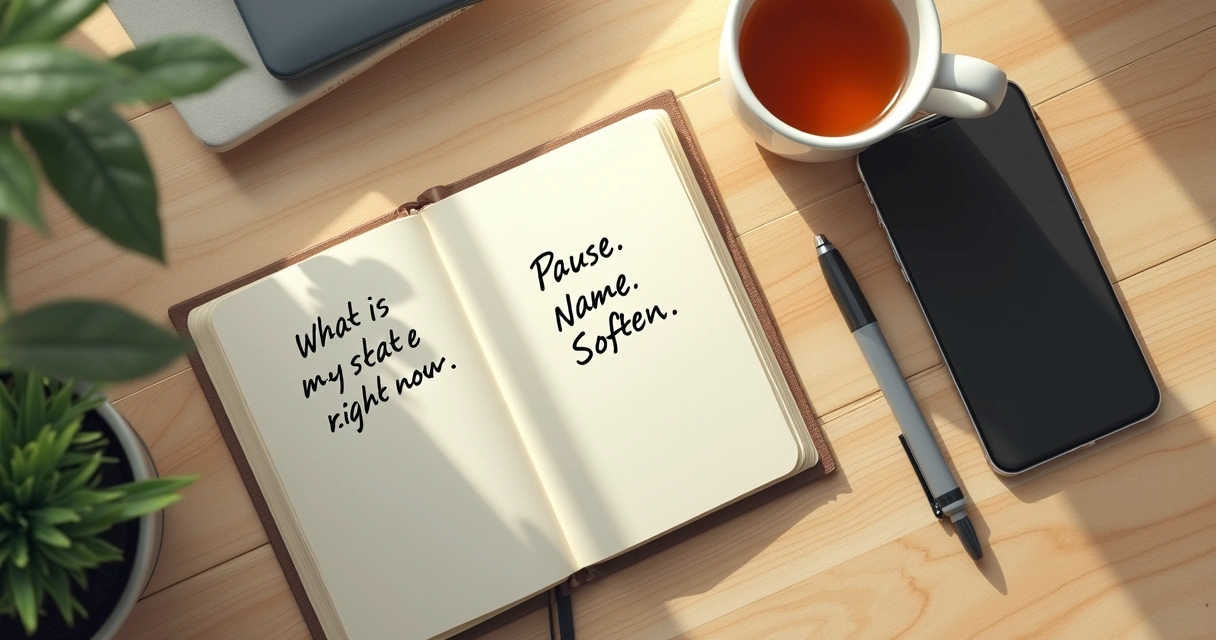
First, pause. Second, name. Third, soften.
Pause for one breath. Not ten. Just one full inhale and one slow exhale.
Name the state. Say internally, “I feel irritated,” “I feel exposed,” or “I feel rushed.” Naming reduces confusion.
Soften one point in the body. Loosen the jaw, drop the shoulders, or unclench the hands.
This sequence may look small, yet it can change the next sentence we speak. A randomized controlled trial on mindfulness training reported gains in mindfulness and self-compassion, along with lower worry, lower anger suppression, and fewer difficulties in emotion regulation, as shown in research on Mindfulness-Based Stress Reduction.
We like this approach because it is usable at a desk, in traffic, during conflict, or while reading a message that stirs us.
Name the emotion with plain language
Some people stay stuck because every feeling gets labeled as stress. But stress is often the cover word, not the exact state. Under it may be shame, fear, envy, sadness, overload, or disappointment.
The more precise we are, the less power the emotion has to hide.
We do not need advanced vocabulary. In fact, simple words work better in tense moments. We can say:
I feel cornered.
I feel ignored.
I feel ashamed.
I feel pressured.
A 2024 meta-analysis of 110 studies on mindfulness-based emotion regulation strategies found meaningful effects on emotion regulation, with monitoring and equanimity standing out. That supports a simple truth: noticing what we feel, without immediate struggle against it, helps regulation happen.
Change the tempo of your response
Not every emotional shift needs silence, but many need a slower reply. This is one of the most useful forms of self-calibration because it works in live conversation.
Instead of answering at the speed of the trigger, we can change the tempo. We might say, “Give us a second to think about that,” or “We want to answer carefully.” A slower pace protects truth. It also protects relationships.
We once saw a person in a tense discussion stop, look down for two seconds, and take one breath before speaking. The room changed. Nothing dramatic happened. Still, everyone felt it. The pause prevented escalation.
A calm second can prevent a long regret.
A review on neurobiological mechanisms of mindfulness and emotion regulation points to changes in brain areas tied to attention, regulation, and self-referential processing. In plain terms, repeated practice can support a different inner response pattern.
Create tiny checkpoints in the day
Real-time calibration becomes easier when we do not start from zero each time. Small checkpoints during the day build familiarity with our internal signals.
We suggest linking the practice to moments that already exist:
Before opening email
Before entering a meeting
After finishing a call
Before answering a hard message
At each checkpoint, we can ask one question: “What is my state right now?” Not the whole story. Just the state.
A 2019 study comparing stages of mindfulness meditation training found that both newer and more experienced practitioners improved emotion regulation, with stronger reduction in negative emotions among those with more advanced practice, according to research on meditation training stages and emotional regulation. We read that as encouraging news. We do not need perfection to begin. Repetition shapes capacity.
Conclusion
Emotional self-calibration is a daily discipline of honest adjustment. We notice the body. We name the feeling. We slow the reaction. We return to a steadier state before words and actions go too far.
The goal is not to feel less, but to act with more inner alignment while feeling.
When we practice in small moments, we become more trustworthy in larger ones. This changes conversations, decisions, and the tone we bring into shared spaces. The work is subtle. The effect is not.
Frequently asked questions
What is emotional self-calibration?
Emotional self-calibration is the practice of noticing our emotional state as it shifts and making small adjustments before reacting. It includes awareness of the body, clearer naming of feelings, and a more conscious response.
How can I practice self-calibration daily?
We can practice daily by using short check-ins at set moments, such as before a meeting, after a call, or before replying to a difficult message. A simple method is to pause for one breath, name the emotion, and relax one part of the body.
What are the benefits of self-calibration?
The benefits include less impulsive speech, more clarity during tension, better emotional awareness, and healthier relationships. Over time, it can also support a steadier mind and a more balanced way of dealing with conflict.
Is emotional self-calibration effective for stress?
Yes. It can help with stress because it interrupts automatic reactions and brings attention back to the present moment. Research on mindfulness-based practices shows reduced negative emotional responses and better regulation under strain.
How do I know if it’s working?
We usually know it is working when there is a little more space between trigger and response. We may still feel anger, fear, or pressure, but we recover faster, speak with more care, and regret fewer reactions afterward.